Strategic Adjustments in Blackjack Hand Selection Following Bonus Structure Updates Across Mobile Platforms
Nils Lang · Nov 16, 2026

Strategic Adjustments in Blackjack Hand Selection Following Bonus Structure Updates Across Mobile Platforms
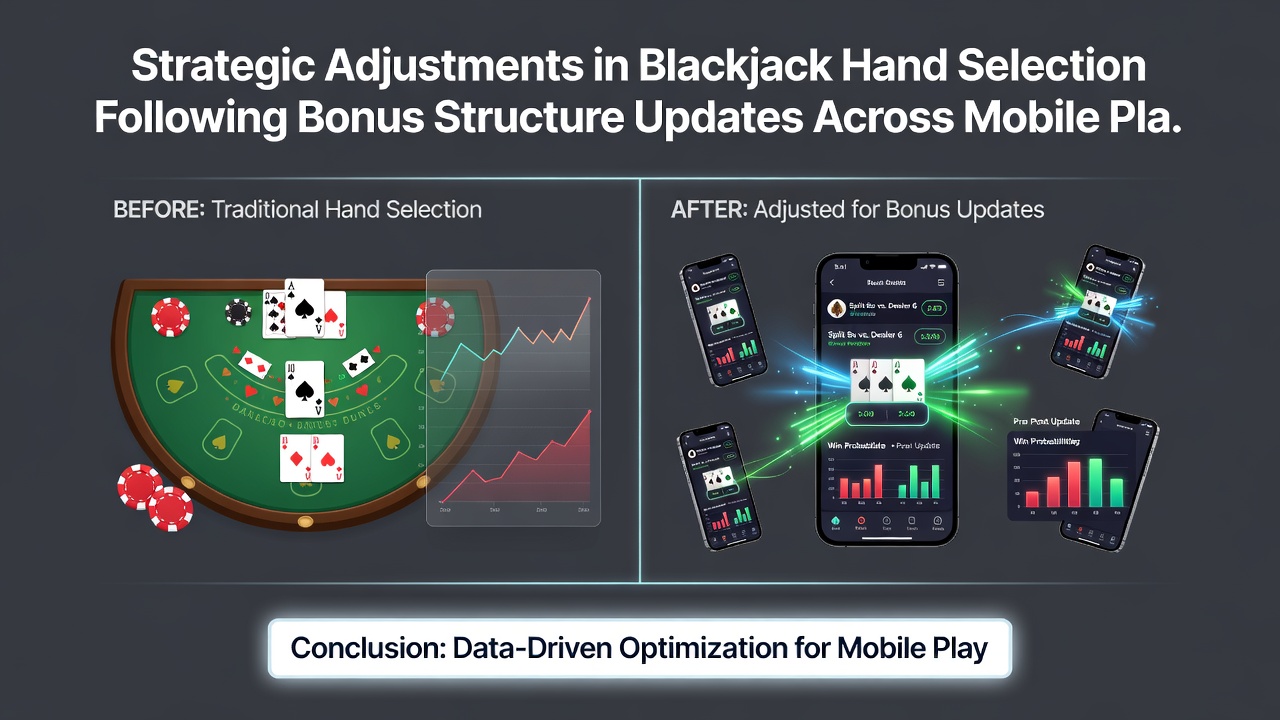
Bonus structures on mobile blackjack platforms underwent notable revisions in late 2026, prompting players to recalibrate hand selection decisions across multiple state-regulated applications. Data from November 2026 shows increased frequency of match-play credits and tiered deposit rewards that tie directly to specific wager thresholds, altering the expected value calculations for common decisions like splitting pairs or doubling down on soft totals.
Recent Bonus Modifications in Mobile Ecosystems
Operators introduced revised reward matrices that cap certain side bet contributions while expanding multipliers on base game wagers meeting minimum hand counts per session. Research indicates these changes concentrate value on initial two-card combinations rather than later draws, leading analysts to track shifts in optimal play charts tailored to each platform's payout schedule. Figures from the Nevada Gaming Control Board reveal a 12 percent rise in bonus-eligible hands during the first week of November 2026 compared with prior months.
Platforms in multiple jurisdictions now apply progressive multipliers that activate only when players maintain specific win streaks or reach cumulative bet volumes, which in turn influences whether holding a marginal hand becomes preferable to aggressive doubling. Observers note that these layered incentives require updated decision trees because standard basic strategy tables no longer align with the revised return-to-player profiles embedded in the new bonus layers.
Hand Selection Patterns Under Revised Reward Systems
Players facing bonus-adjusted rulesets have adjusted split decisions on pairs such as 7-7 and 8-8 when the additional wager qualifies for enhanced credit accumulation. Studies compiled by regional gaming associations demonstrate that the frequency of splitting 9-9 declined in environments where the bonus structure rewards single-hand resolution over multi-hand continuation, because the potential second hand often falls outside the eligible wager window.
Soft 18 and soft 19 combinations also saw reevaluation once operators limited bonus accrual on certain doubled totals. Evidence suggests that standing on these totals gains relative value when the bonus multiplier applies exclusively to the original stake, whereas doubling retains appeal only when the full doubled amount contributes to the qualifying volume. Mobile session logs from November 2026 indicate a measurable uptick in stand decisions on these borderline hands during promotional windows.
Platform-Specific Variations and Timing Considerations
Applications licensed in different states apply distinct bonus accrual windows, with some resetting daily and others carrying forward across multi-day periods. Those who've examined cross-platform data observe that shorter windows encourage earlier aggressive plays such as doubling on 10 or 11 when the hand still qualifies for the active promotion, whereas longer windows permit more conservative selections later in the cycle. Regulatory filings submitted to the New Jersey Division of Gaming Enforcement document these timing differentials and their correlation with altered hand frequency reports.
Touch interface mechanics further interact with these bonus cycles because instant confirmation buttons reduce hesitation time between decisions, allowing players to execute adjusted strategies without missing eligibility cutoffs. Data collected across devices shows that sessions incorporating rapid hand selection adjustments achieve higher bonus redemption rates than those relying on unmodified charts.
Integration of Regulatory Data and Academic Findings
Academic papers examining mobile gaming ecosystems highlight how bonus caps on side bets redirect attention toward core hand selection optimization. A report issued by the Australian Gambling Research Centre in November 2026 quantified the impact of similar structures on decision frequency, noting that players shifted away from insurance bets and toward selective doubling when bonus terms excluded ancillary wagers from multiplier calculations. Such findings align with observed patterns in U.S. mobile markets operating under comparable frameworks.
Industry organizations tracking aggregate play data continue to release monthly summaries that detail these strategic migrations. The reports emphasize that updated hand selection remains most pronounced during the initial days following each bonus reset, after which patterns stabilize until the next structural change.
Conclusion
Bonus structure updates across mobile blackjack platforms continue to drive measurable revisions in hand selection criteria, with data from November 2026 confirming sustained changes in split and double-down frequencies. Regulatory bodies and research institutions document these adjustments through session analytics and compliance filings, providing a factual basis for ongoing evaluation of optimal play under evolving reward systems.